Thursday, December 13, 2007
The Opium Wars
The Opium war was based on the British forcing its way for trading opium for tea into China. The British wanted China to trade with them, but China refused to do so because they believed they were self-sufficient and independent. China produced their own goods for their people and had no needs to trade for other's produced goods. Once China agreed to trade with the British they wanted silver in return for their tea. The British were then obligated to trade their silver for the Chinese tea. As time went on the British were running out of silver and they were left with the burden of finding another produced good to trade for tea. The British then introduced their new good to China, which was opium. The people of China welcomed the opium and became addicted to the drug. The economy of China soon began to change, the farmers began lacking in producing farm goods for the people, and the Chinese army soon began to crumble or break down. When the emperor of China realized the breakdown of the economy was caused by this drug opium, he sent a letter out to Queen Victoria, but the letter never made it to her. The British refused to stop distributing the drug to China and they were forced to take action by burning the opium trade ports. As a result of the action the Chinese took, Britain declared war. Britain had more advanced battle warfare tactics that resulted in a easy victory against China.

Monday, December 10, 2007
"The White Man's Burden"
The "white man's burden" is a poem based on imperialism. It was written based on the war of the U.S. trying to take control of the Philippines, this was during the Spanish-American war. It's a description on the task the white men are obligated to take in order to take action on the take over of other countries. I agree with the poem because it describes how the white people tried to take over weaker countries. America is still living the "white man's burden" today because even though America has won the war in Iraq, our armies still continue to take action towards their obligation on changing the Iraq government.
Wednesday, December 5, 2007
"The Scramble for Africa"
The European people believed that their race was superior to any other race in the world. They believed that it was their duty to take over other countries to expand the European race. One country the Europeans believed they could've conquered was the continent of Africa. When Europe's control over Africa expanded, many European nations wanted area of their own ruling. Many of the European nations then started controlling many parts of Africa. Major European nations that had control of areas in Africa were France, Britain, Portugal, Belgium, Germany, Italy, and Spain. They would take control of these areas in Africa because of their rich natural resources. These nations would use these natural resources to produce products to sell to the people of Europe and as well as the people of Africa. The nations would also take control of these areas because the more land they owned, the more power they had. They were able to dominate Africa so easily due to their advanced technology. They had the advantage over them because Africa was a lot weaker. Some African tribes also gave up their land to the European nations so that they wouldn't take it by force. The aftermath of the scramble had major effect on the African people because many tribes of Africa were separated into different portions due to the boundaries created by the European nations.
Monday, December 3, 2007
Film Lesson: "Mountains of the Moon"
As the Europeans explored Africa, they faced many hardships. Throughout their journey they would encounter random brutal attacks from other African tribes that would force them to abandon their journey. They would come across a number of dangerous ferocious wild animals like lions and tigers, but didn't cause any deaths. The slaves that were brought on the trip would also cause hardships, stealing goods and food and running away with it. The conditions that the ground was in were horrible, with big rocks that would interfere. The weather would also be a major factor to effect the slaves during the exploration that would cause deaths and less help for the rest of the trip. Many things hurt the exploration on the search of the source of the Nile River, due to all these negative aspects it slowed the journey down, but they still managed to get through it all. It's strange that the source of the Nile River is named after a British Queen because the lake is located in Africa. The founders of the lake were European, therefore they named it after their queen. Its all due to imperialism. They had the power to overcome Africa because they had more power and the right to name it of their choice. And still today, the lake is called Lake Victoria. The European had a primary technological advantage over the African people which were mainly weapons, medicine, and utensils. They had a lot more power due to advanced weapons such as guns. They had a lot more food, medicine, and utensils for survival and power over the African people. Due to all this the Europeans eventually were able to conquer Africa. They had no defense to help them counter back. This is another example of imperialism. Europeans had the upper hand, with more power, to take over the more weaker, which was Africa.
Tuesday, November 27, 2007
The Meiji Restoration of Japan
Japan is a archipelago because it is made up of many islands. Before Japan opened its trade routes to any other foreign countries they were isolated. In their state of being isolated they had no contact or communication with countries. Due to the fact that they were isolated for so long, they were trapped in time with their old technology, not knowing about all the new technology that was actually out there. Mathew Perry bullied Japan into signing a trade treaty due to their opposition towards the American. When Mathew Perry brought the ships to the ports of Japan, the Japanese were shocked to see the technology the Americans had, such as steamboats and rifles. The American needed to Japan to open their trade ports so that American ships could use Japan as a refill station. American ships would use these ports to refill in food, water, and coal. During the Meiji Era, Japan threw away the whole idea of feudalism. In 1668, the emperor Mutsuhito took back his thrown in Japan. He believed in order for Japan to be equal in political and economically was by sending Japanese scholars to America to learn and bring back the Western ways to Japan. They began to modernize and industrialize by the teachings of the Western ways. The scholars brought back the ways of industrializing railroads and factories to produce goods.
Tuesday, November 13, 2007
Karl Marx and Communism

Karl Marx's idea of Communism came about during the Industrial Revolution and his main aspect was to change ways for these workers being controlled by religion. It all came together as basically a society of workers distributing their earnings equally amongst each other. If one was in need, he was to be distributed the amount of money he needed and/or if one worked to his ability, he was to be distributed the amount of pay he earned. Communism came about to try and change laws
Friday, November 9, 2007
Karl Marx and the Industrial Revolution

Karl Marx felt that the hard working people in factories and farms should be in control of everything instead of having owners or landlords to order them. He did not like the ways the Industrial Revolution was turning out. Because of this, it came to him to unite all these people to go against the law of owners and landlords. Thats where communism came about. Karl Marx believed that if people worked together doing similar jobs, they should of all been distributed their earnings equally, as one. He inspired many to take his lead to demand this law to be changed. Communism is still popular today and it all began with a man trying to improve laws for these hard working people during the Industrial Revolution, thanks to Karl Marx.
Friday, October 19, 2007
Nationalism and the Creation of Italy
Nationalism is a way to express your custom and show pride to your country. To be devoted to where you from and stand for your culture and represent. It brings people together as one, as a nation. I'm a nationalistic in many ways. By only wearing your country's colors of the flag your showing nationalism. The majority of people celebrate holidays such as our independence day, July 4th where you go to see fireworks only on that special day. Celebrating common holidays such as Halloween, thanksgiving, or Christmas is showing that you take part of your nation and shows nationalism. The simple tasks of only saying the Pledge of Allegiance every morning in school shows nationalism, and/or saluting the American flag as well. Showing respect and ethnicity for your country is a simple way to describe nationalism.

Italy is a perfect example for nationalism. Nationalism is what brought the people together in Italy and helped them succeed towards their unification. Austria ruled part of Italy during 1815. While time went on, more and more Italians felt they were fed up with their foreign rules, which led them to wanting change. A group by the name Young Italy, which was organized by Giuseppe Mazzini, was a group that contributed towards their unification. Camillo di Cavour also was a another leader that helped lead Italy towards the act of nationalism. Then, with the help of Napoleon the third, they went to war with Austria and were victorious on taking over all of northern Italy. Giuseppe Garibaldi also was one of the leaders to help Italy out. He led a group of army called the Red Shirts and helped out on uniting the southern part of Italy. From the brave actions of these men, Italy became one, with the leaders and all the other people taking part in the quest.
Italy is a perfect example for nationalism. Nationalism is what brought the people together in Italy and helped them succeed towards their unification. Austria ruled part of Italy during 1815. While time went on, more and more Italians felt they were fed up with their foreign rules, which led them to wanting change. A group by the name Young Italy, which was organized by Giuseppe Mazzini, was a group that contributed towards their unification. Camillo di Cavour also was a another leader that helped lead Italy towards the act of nationalism. Then, with the help of Napoleon the third, they went to war with Austria and were victorious on taking over all of northern Italy. Giuseppe Garibaldi also was one of the leaders to help Italy out. He led a group of army called the Red Shirts and helped out on uniting the southern part of Italy. From the brave actions of these men, Italy became one, with the leaders and all the other people taking part in the quest.
Tuesday, October 16, 2007
Simon Bolivar and Latin American Revolutions

Simon Bolivar was born on July 24, 1783 to a wealthy family in Caracas, Venezuela. He was known best to stand up for the name given to him as "The Liberator". In the early nineteenth century he led a military with an army no bigger than ten thousand men to free the northern portion of South America from the Spanish. He helped liberate his people of Venezuela, and also other countries such as Colombia, Ecuador, Peru, and Bolivia. The country of Bolivia was named after him in 1825 because the people of Bolivia were grateful for his accomplishment and wanted to honor him as their liberator. Simon Bolivar was inspired by most of the Enlightenment thinkers such as Rousseau, John Locke, and Voltaire and also by Napoleon's great accomplishments. He then decided to take action because he believed his country was to be granted liberty, as was the United States and other countries, and decided to be the leader for all this. He traveled around the world to many other countries and gathered up many other people that helped him in his chase for freedom in South America. His reputation grew larger as the leader in the movement for independence which was another factor helping him to gather his armies and trusted leaders. He fought through many wars, with so little men as his army, he still managed to be victorious in most his battles. Simon Bolivar was a great man of honor with many successful accomplishments that are still in effect 'till this day. Thanks to him, South America has its independence and is a continent that should be known after it's main leader, after Simon Bolivar.
Friday, September 28, 2007
Robespierre and The Reign of Terror
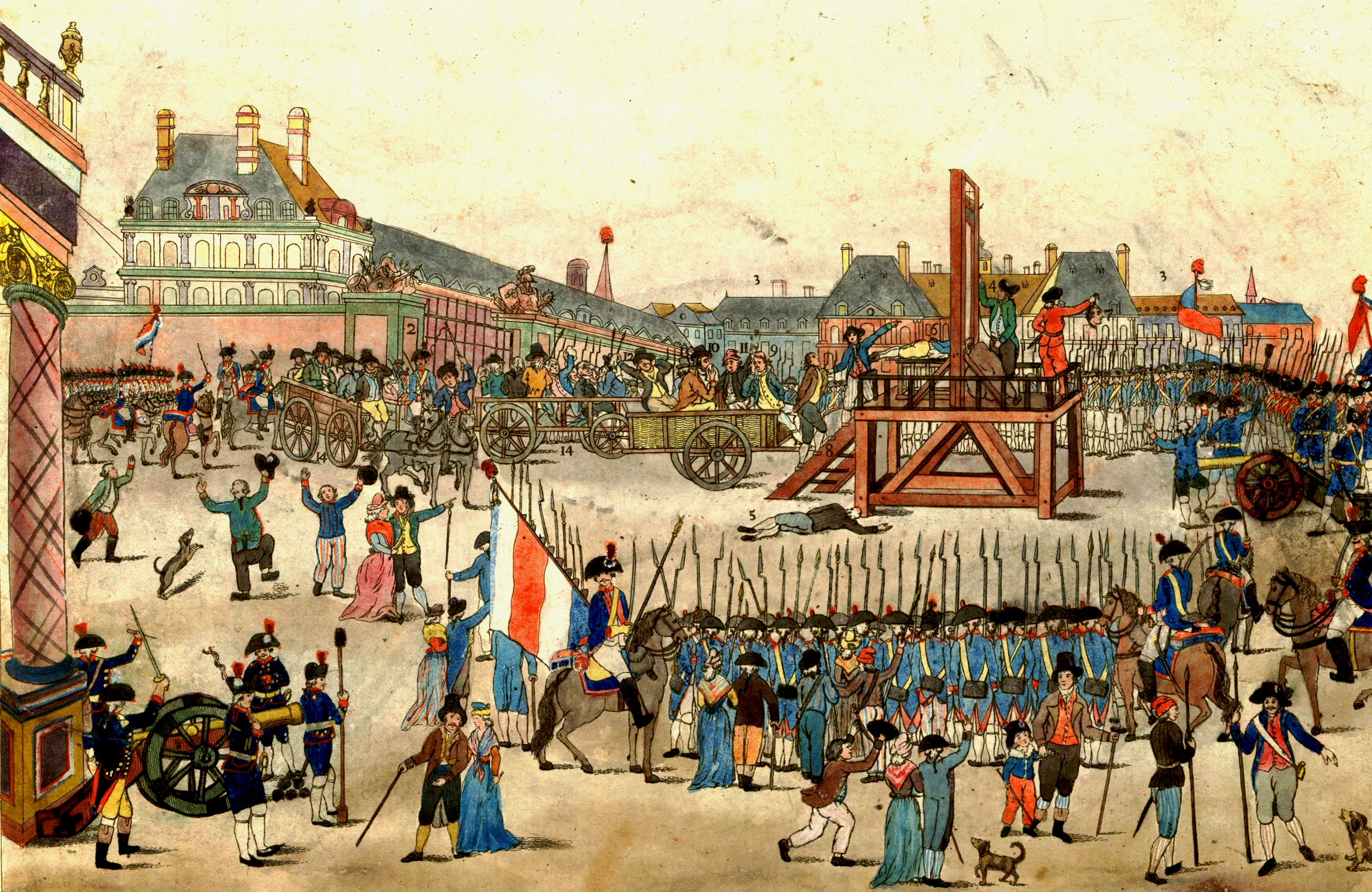
Maximilien Robespierre was the most dominant leader during the French Revolution. He arose into the revolution and took control of the government to wipe out any trace of the old monarchy. Robespierre made many changes on France, for example he removed Sundays from the calender because he believed religion was old fashioned. He then ruled France for a time period, and his rule was called The Reign of Terror.
The Reign of Terror was a ten month crisis that occurred during the French Revolution, from September 15, 1793 to July 28, 1794. The terror was caused by struggles between rival factions led to mutual radicalization. The terror took many people's lives amounting between 18,500 to 40,000 deaths. France was then instituted to rule the country in a national emergency because of all the waves of executions being held. This all came about because of the inequality of rights between the lower and higher classes and other aspects such as freedom.
The terror was taking in action by chopping people's heads off using the guillotine
The French Revolution: Social Causes

The Frech Revolution was an event that took place in Europe during a ten year period from 1789 to 1799. It came right after the American Revolution which occured only a decade ealier. France was the most advanced and the most wealthiest country in Europe, with a large population and a prosperous foreign trade. France's culture was widely praised and emulated by the rest of the world. But all this success hadn't led to good only, with high taxes, high prices, and disturbing questions raised by The Enlightenment ideas of Rousseau and Voltaire, came to a great unrest in France. The Revolution was helped caused due to the economic and inequalities in the Old Regime. The French Revolution caused the transformation of France, which went from absolute monarchy to a republic of theoritically free and equalized people. A feudalized system came about in the 1770's called the Old Regime. This caused France to be divided into three larger social groups, or estates.
The first estate were clergy of the Roman Catholic Church and only made up 1 percent of the population in France. They had privilages including access to high offices and exemptions from paying taxes, and owned 10 percent of the land in France. It provided education and relief services to the poor and only contributed 2 percent of its income to the government. They scorned the Enlightenment ideas.
The second estate were made up of rich nobles and only made up 2 percent of France. Most of their wealth was off land they owned. The nobles owned 20 percent of the land and paid no taxes. They also scorned The Enlightenment ideas as radical notions that threatened their status and power as privileged persons.
The third estate was made up of three different groups. The peasant farmers, the bourgeoisie, and the urban lower class. They owned about 98 percent of the land in France and paid 48 percent more of taxes than the other two estates. They had no power to influence the government and they all believed in the Enlightenment ideas. All three groups differed in their economic conditions. The bourgeoisie were merchants and artisans. The bourgeoisie felt their wealth entitled them to a greater degree of social status and political power becuase some were as rich as nobles, but they paid high taxes and lacked privileges just like the others of the third estate. They were well educated people and believed strongly in the Enlightenment ideals of freedom and equality. The urban lower class were the wrokers of France's cities and were made up of cooks, servants, and others. They were poorer than the bourgeuisie and paid low wages and were frequently left without work. They had to attack carts of grain and bread when they were hungry cause they couldn't afford the prices after they were raised. The third and last group were the peasants and were the largest group of the third estate. They made of 80 percent of France. The peasants were heavily taxed, having to pay half of their income in dues to the nobles, tithes of the church, and also to the king's agents. They joined the urban poor in resenting the clergy and the nobles for their privileges and special treatment.
On July 14, 1789 occured a symbolic act of revolution to the French people. It became a national day to all. On this day the Bastille, a Paris prison, fell into control of the citizens after they overwhelmed the king's soldiers. This came to the end of absolute monarchy and a new beggining of a better government.
Tuesday, September 11, 2007
Copernicus and the trial of Galileo

In the early 1500's there were two main theories of the solar system. One being the geocentric theory and the other being the heliocentric theory. The geocentric theory came before the heliocentric theory, long ago in the Ancient Greek times around 500-400 B.C. The theory came from Ptolomey who believed that the Earth was the center of the whole solar system and that the sun and the other planets orbit around it. It was then replaced with another more accurate theory that came from the scientific revolution. The heliocentric theory, which stated that the Earth is simply only one of the planets that orbit around the sun. It was the correct theory which came from Nicolas Copernicus around 1500's - 1600's A.D. and it wasn't believed till then.
Galileo Galilei was the most successful scientist during the Scientific Revolution. He invented the telescope and the microscope along with other discoveries. He used his observations of the universe using his telescope and combined it with his laws of physics to defend the heliocentric theory. Galilieo was then put on trial because he defended and believed the theory, and for publishing a book based on both theories on which one was right from wrong. The Roman Catholic Church didn't like this because they thought he was wrong and only depended on God toward their beliefs about the earth. He was forced to reanounce his views and submit to the church. He was then sentenced to do life on house arrest. In 1633 he was inprisoned and then died 9 years later in 1942 at the age of seventy-seven, causing the Itilian Rennaissance to come to an end. It was then proven many years later in 1992 that Galileo Galilei was right about everything, by the Roman Catholic Church.
Monday, September 10, 2007
Scientific Revolution: Scientific Method

The scientific revolution caused an outcome of success which came to the discovery of a simple logical way to make proof of someones beliefs upon the earth and/or universe. The scientific method was then introduced as the new way of challenging others ideas and proving whats right from wrong. The cause of the scientific method was brought on due to a Greek philosopher named Aristotle who only thought things were true because it was the way it ought to be. A well known example for Aristotle's mistake on science was the theory on which heavy objects would fall faster than small objects. He was proven wrong by Galileo, a great scientist, using the Scientific Method. The scientific method is a procedure of four steps:
1. Observation and description of a phenomenon or group of phenomena.
2. Formulation of an hypothesis to explain the phenomena. In physics, the hypothesis often takes the form of a causal mechanism or a mathematical relation. 3. Use of the hypothesis to predict the existence of other phenomena, or to predict quantitatively the results of new observations.
4. Performance of experimental tests of the predictions by several independent experimenters and properly performed experiments.
From a mistake of a scientist, and another scientist not approving the other's belief, came an extremely useful method which is still used today.
Thursday, September 6, 2007
Evolution vs. Creation

Darwin's Theory of Evolution is based on natural selection and the beliefs of Charles Darwin upon the development of life from non-life, stating that living creatures all came from common ancestors. Natural selection is a way of explaining the superior species from the inferior species of the same kind, as overtime the inferior become extinct and the superior pick up abilities from its offspring to still survive and move on to compete against the world with more advantages. Breeding has a big part in natural selection. Its a way to test, produce, compare, or eliminate the differentiated species of life. Breeding is done naturally over time or also by human breeders as well. Natural selection is a act of taking advantages of slight successive variations. Taking short steps and being completely sure is said to be a better advance than taking big leaps to exceed and still not be sure. Natural selection is the simple explination based on the variations in every population of living things and the organisms competing for limited resources in life.

Creationism is the wide spectrums of beliefs upon life, earth, the universe, and humanity which were all created by dieties. Creation of life form, earth, etc., hasn't been proven by anyone still till' today, the reason why so many argue and debate over. Public schools don't allow creationism to be taught because of the beliefs and religous outcomes towards the subject. With so many creationists all over the world nobody knows who or what to believe. Creationism is the presumption that life was created by either a god or their own beliefs upon their own knowledge on creationism.
Subscribe to:
Posts (Atom)