Friday, September 28, 2007

Robespierre and The Reign of Terror


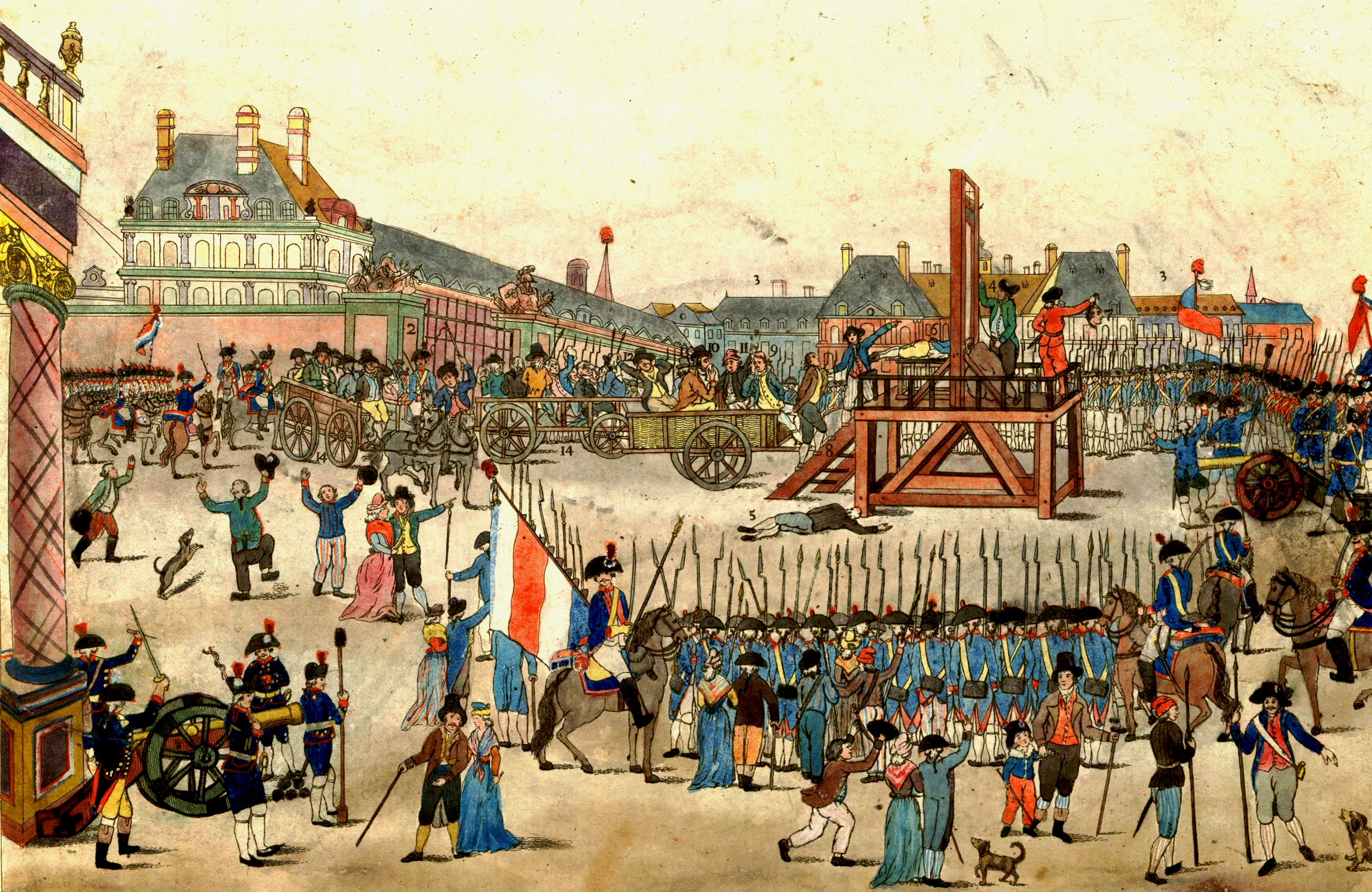
Maximilien Robespierre was the most dominant leader during the French Revolution. He arose into the revolution and took control of the government to wipe out any trace of the old monarchy. Robespierre made many changes on France, for example he removed Sundays from the calender because he believed religion was old fashioned. He then ruled France for a time period, and his rule was called The Reign of Terror.
The Reign of Terror was a ten month crisis that occurred during the French Revolution, from September 15, 1793 to July 28, 1794. The terror was caused by struggles between rival factions led to mutual radicalization. The terror took many people's lives amounting between 18,500 to 40,000 deaths. France was then instituted to rule the country in a national emergency because of all the waves of executions being held. This all came about because of the inequality of rights between the lower and higher classes and other aspects such as freedom.
The terror was taking in action by chopping people's heads off using the guillotine

The French Revolution: Social Causes


The Frech Revolution was an event that took place in Europe during a ten year period from 1789 to 1799. It came right after the American Revolution which occured only a decade ealier. France was the most advanced and the most wealthiest country in Europe, with a large population and a prosperous foreign trade. France's culture was widely praised and emulated by the rest of the world. But all this success hadn't led to good only, with high taxes, high prices, and disturbing questions raised by The Enlightenment ideas of Rousseau and Voltaire, came to a great unrest in France. The Revolution was helped caused due to the economic and inequalities in the Old Regime. The French Revolution caused the transformation of France, which went from absolute monarchy to a republic of theoritically free and equalized people. A feudalized system came about in the 1770's called the Old Regime. This caused France to be divided into three larger social groups, or estates.
The first estate were clergy of the Roman Catholic Church and only made up 1 percent of the population in France. They had privilages including access to high offices and exemptions from paying taxes, and owned 10 percent of the land in France. It provided education and relief services to the poor and only contributed 2 percent of its income to the government. They scorned the Enlightenment ideas.
The second estate were made up of rich nobles and only made up 2 percent of France. Most of their wealth was off land they owned. The nobles owned 20 percent of the land and paid no taxes. They also scorned The Enlightenment ideas as radical notions that threatened their status and power as privileged persons.
The third estate was made up of three different groups. The peasant farmers, the bourgeoisie, and the urban lower class. They owned about 98 percent of the land in France and paid 48 percent more of taxes than the other two estates. They had no power to influence the government and they all believed in the Enlightenment ideas. All three groups differed in their economic conditions. The bourgeoisie were merchants and artisans. The bourgeoisie felt their wealth entitled them to a greater degree of social status and political power becuase some were as rich as nobles, but they paid high taxes and lacked privileges just like the others of the third estate. They were well educated people and believed strongly in the Enlightenment ideals of freedom and equality. The urban lower class were the wrokers of France's cities and were made up of cooks, servants, and others. They were poorer than the bourgeuisie and paid low wages and were frequently left without work. They had to attack carts of grain and bread when they were hungry cause they couldn't afford the prices after they were raised. The third and last group were the peasants and were the largest group of the third estate. They made of 80 percent of France. The peasants were heavily taxed, having to pay half of their income in dues to the nobles, tithes of the church, and also to the king's agents. They joined the urban poor in resenting the clergy and the nobles for their privileges and special treatment.
On July 14, 1789 occured a symbolic act of revolution to the French people. It became a national day to all. On this day the Bastille, a Paris prison, fell into control of the citizens after they overwhelmed the king's soldiers. This came to the end of absolute monarchy and a new beggining of a better government.
Tuesday, September 11, 2007

Copernicus and the trial of Galileo


In the early 1500's there were two main theories of the solar system. One being the geocentric theory and the other being the heliocentric theory. The geocentric theory came before the heliocentric theory, long ago in the Ancient Greek times around 500-400 B.C. The theory came from Ptolomey who believed that the Earth was the center of the whole solar system and that the sun and the other planets orbit around it. It was then replaced with another more accurate theory that came from the scientific revolution. The heliocentric theory, which stated that the Earth is simply only one of the planets that orbit around the sun. It was the correct theory which came from Nicolas Copernicus around 1500's - 1600's A.D. and it wasn't believed till then.

Galileo Galilei was the most successful scientist during the Scientific Revolution. He invented the telescope and the microscope along with other discoveries. He used his observations of the universe using his telescope and combined it with his laws of physics to defend the heliocentric theory. Galilieo was then put on trial because he defended and believed the theory, and for publishing a book based on both theories on which one was right from wrong. The Roman Catholic Church didn't like this because they thought he was wrong and only depended on God toward their beliefs about the earth. He was forced to reanounce his views and submit to the church. He was then sentenced to do life on house arrest. In 1633 he was inprisoned and then died 9 years later in 1942 at the age of seventy-seven, causing the Itilian Rennaissance to come to an end. It was then proven many years later in 1992 that Galileo Galilei was right about everything, by the Roman Catholic Church.

Monday, September 10, 2007

Scientific Revolution: Scientific Method


The scientific revolution caused an outcome of success which came to the discovery of a simple logical way to make proof of someones beliefs upon the earth and/or universe. The scientific method was then introduced as the new way of challenging others ideas and proving whats right from wrong. The cause of the scientific method was brought on due to a Greek philosopher named Aristotle who only thought things were true because it was the way it ought to be. A well known example for Aristotle's mistake on science was the theory on which heavy objects would fall faster than small objects. He was proven wrong by Galileo, a great scientist, using the Scientific Method. The scientific method is a procedure of four steps:
1. Observation and description of a phenomenon or group of phenomena.
2. Formulation of an hypothesis to explain the phenomena. In physics, the hypothesis often takes the form of a causal mechanism or a mathematical relation. 3. Use of the hypothesis to predict the existence of other phenomena, or to predict quantitatively the results of new observations.
4. Performance of experimental tests of the predictions by several independent experimenters and properly performed experiments.
From a mistake of a scientist, and another scientist not approving the other's belief, came an extremely useful method which is still used today.

Thursday, September 6, 2007

Evolution vs. Creation


Darwin's Theory of Evolution is based on natural selection and the beliefs of Charles Darwin upon the development of life from non-life, stating that living creatures all came from common ancestors. Natural selection is a way of explaining the superior species from the inferior species of the same kind, as overtime the inferior become extinct and the superior pick up abilities from its offspring to still survive and move on to compete against the world with more advantages. Breeding has a big part in natural selection. Its a way to test, produce, compare, or eliminate the differentiated species of life. Breeding is done naturally over time or also by human breeders as well. Natural selection is a act of taking advantages of slight successive variations. Taking short steps and being completely sure is said to be a better advance than taking big leaps to exceed and still not be sure. Natural selection is the simple explination based on the variations in every population of living things and the organisms competing for limited resources in life.


Creationism is the wide spectrums of beliefs upon life, earth, the universe, and humanity which were all created by dieties. Creation of life form, earth, etc., hasn't been proven by anyone still till' today, the reason why so many argue and debate over. Public schools don't allow creationism to be taught because of the beliefs and religous outcomes towards the subject. With so many creationists all over the world nobody knows who or what to believe. Creationism is the presumption that life was created by either a god or their own beliefs upon their own knowledge on creationism.